
If you just got a new Instant Pot and are looking for Instant Pot directions, this beginner’s guide will help you learn how to use your Instant Pot electric pressure cooker. With these Instant Pot pressure cooker instructions, you’ll learn about the parts of the Instant Pot, setup, safety features, pressure release, and the water test. [Video included.]
This post contains affiliate links. As an Amazon Associate, I earn from qualifying purchases. Please read the disclosure.
Table of Contents
✏️ IMPORTANT NOTE
There are numerous Instant Pot models, each with its own design. Use this Instant Pot instruction manual to get a basic understanding of the functions. It has everything a beginner needs to get started. If you have questions about how to use another model, try my Instant Pot instructions for beginners with videos:
Instant Pot Parts and Accessories
Make sure all the parts are included. The guide that came with your Instant Pot will tell you what’s included. Here are the common parts of the Instant Pot:
➡ Is your Instant Pot clicking? This is pretty normal!
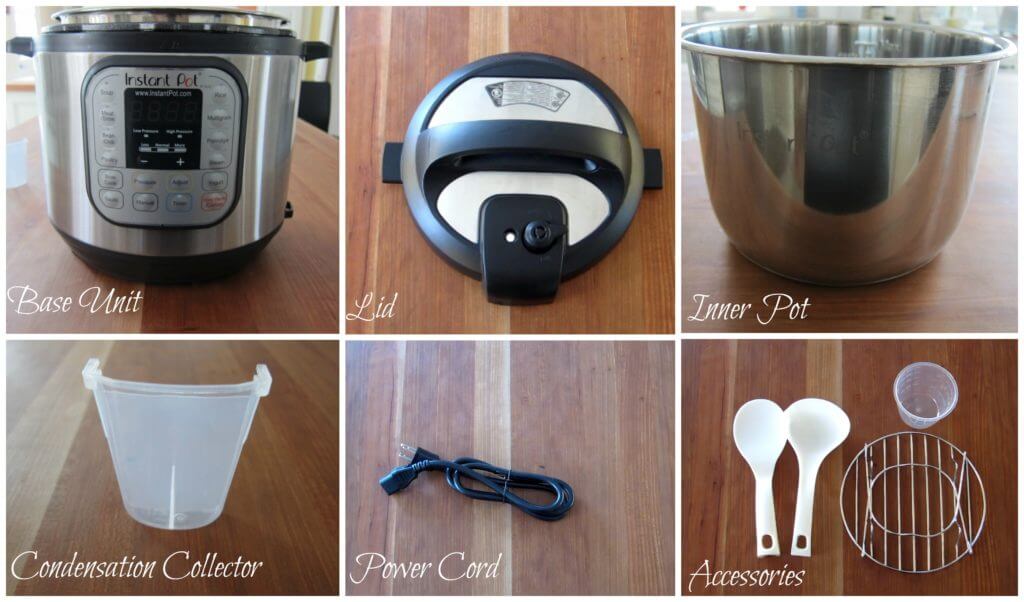
- Base unit/Outer Pot – stainless steel exterior that houses the heating element, control panel, and detachable power cord.
- Lid – closes the Instapot and seals it under pressure.
- Inner pot – removable stainless steel pot, also known as a liner or insert.
- Condensation Collector – catches drips from condensation on the lid.
- Power cord – the 3-prong detachable power cord is plugged into the back of some models. Other models have a permanently attached cord.
- Accessories – may include rice paddle, ladle, measuring cup, and trivet. Some models come with an extra sealing ring.
Instant Pot Lid
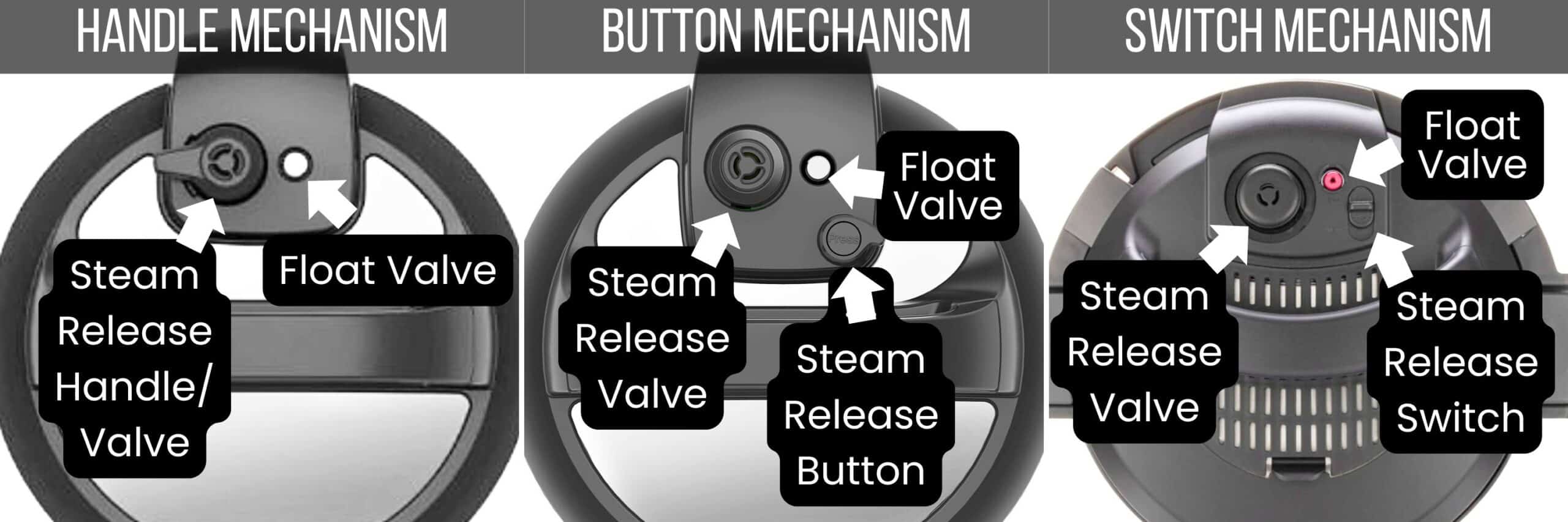
Every Insta Pot model will look slightly different, but the basics are the same. Some lids will have a handle, while others will have a knob or switch to release pressure.
Lid Exterior Parts
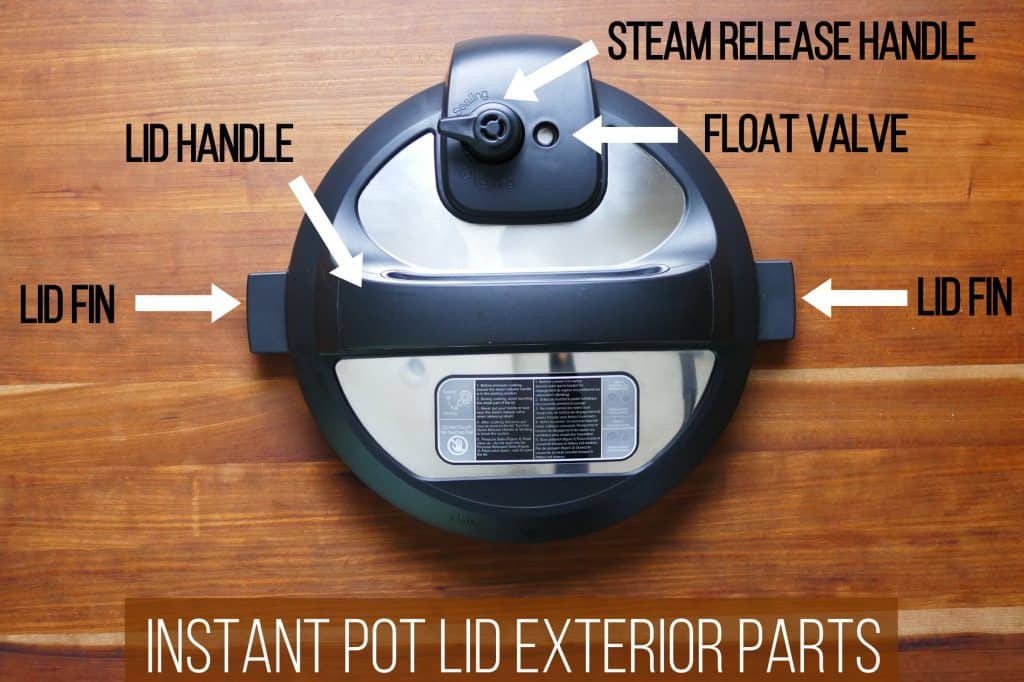
- Lid Handle is used to put on and take off the lid. Some models have a switch, while others have a teardrop-shaped button.
- Lid Fin is placed in the lid fin slot of the base unit to prop the lid open.
- Steam Release Handle is sometimes called the pressure valve, and it fits over the steam release pipe and releases pressure. On some models, the steam release valve has a plastic diffuser that fits over the valve to help the steam release with less force.
- Float Valve seals in the steam, pressurizing the Instant Pot.
Lid Interior Parts
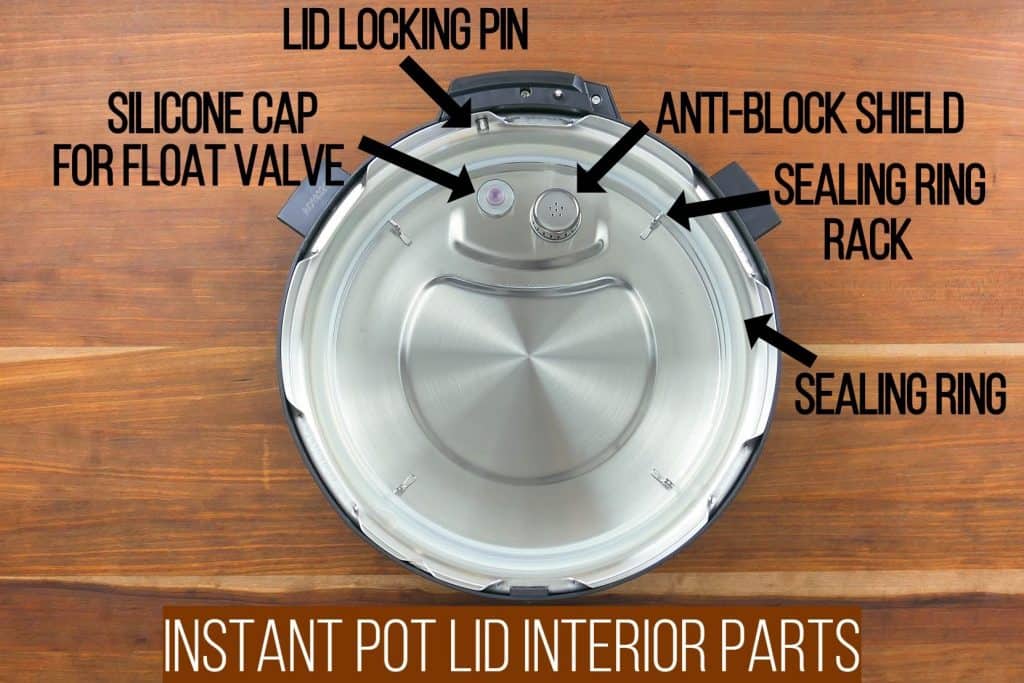
- Silicone Cap for Float Valve covers the instant pot valve and keeps it in place
- Lid Locking Pin is a safety mechanism that prevents the lid from opening under pressure
- Anti-Block Shield prevents food from coming out of the stainless steel inner pot through the steam release pipe
- Sealing Ring Rack – holds the sealing ring in place
- Silicone Sealing Ring allows the Instant Pot to seal
Setting Up
Now that you are familiar with the parts of your Instant Pot, you’re ready to begin setting it up so you can run a water test.
1. Unbox
I regularly hear from people who purchased or got the Instant Pot as a gift and leave it unopened because they’re too intimidated.
If you have a defective unit, you might miss the warranty period if you don’t get it out of the box and try it out!
Place the Instant Pot base unit on a stable surface, away from any open flame. Place it so that the steam won’t blow up onto any cabinets.
2. Place the inner pot in the base unit
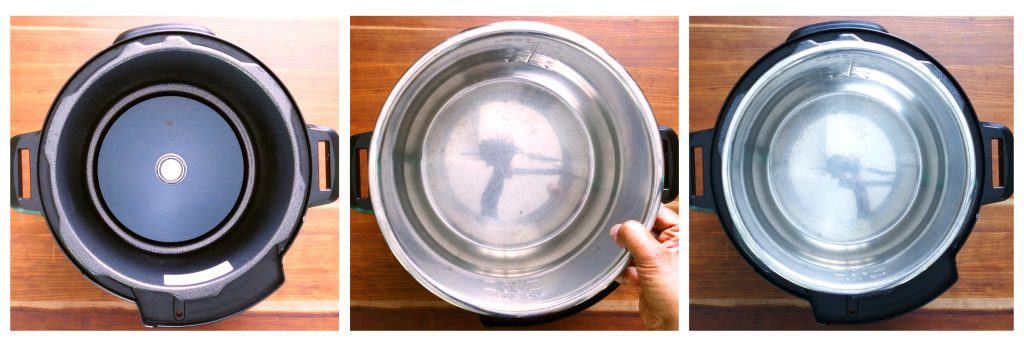
- Make sure the base unit is empty and clean.
- Place the stainless steel inner pot inside the Instant Pot base unit.
3. Attach the condensation collector
The condensation collector catches any moisture that builds up on the rim. This usually comes from moisture dripping from inside the lid into the rim of the Instant Pot base when the lid is opened.
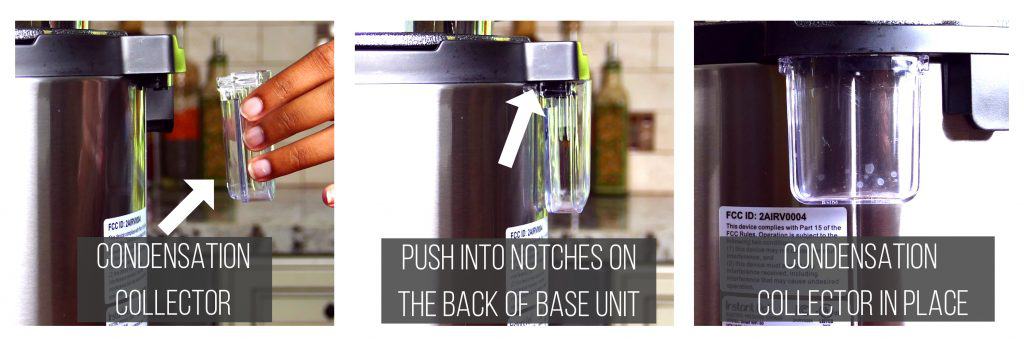
- Line up the condensation collector with the notches on the back of the Instant Pot base unit.
- Slide in the condensation collector until it’s pushed in all the way.
4. Plug in the Instant Pot
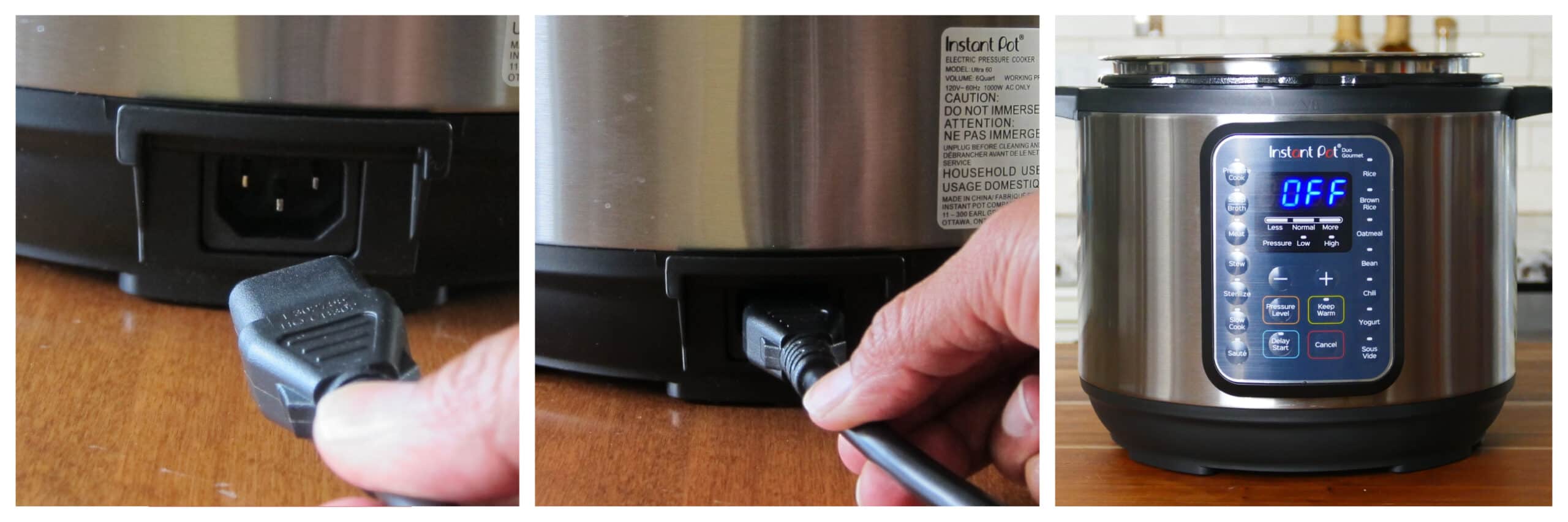
If you have a detachable cord, plug it into the base unit. Plug the cord into an electrical outlet.
Essential Tips Before You Use an Instant Pot Pressure Cooker
Important Information
- There are so many buttons on the Instant Pot, and it can seem overwhelming. You can get by using just a handful of buttons: Pressure Cook, Cancel, Start, and Saute.
- Many buttons or functions on the Instant Pot are presets for pressure cooking various foods, similar to those on a microwave. You can use these shortcuts (e.g., Meat, Soup, Rice) or the Pressure Cook function, which is the same thing.
- Before using the Instant Pot, always have the inner pot (aka liner or insert) in the base unit. Don’t put food or liquid into the Instant Pot base unit! I like to leave a trivet in the base unit when the inner pot is being washed to remind myself and others in the household not to forget the liner.
- The pressure release handle, button, or switch must be in the Sealing position, not Venting.
- The Instant Pot needs a minimum quantity of clear liquid (e.g. water, broth) for pressure cooking. (3 quart – 1 cup, 6 quart 1.5 cups, 8 quart – 2 cups). Some foods, such as vegetables and meats, release liquid during the cooking process, allowing you to use slightly less liquid.
- After using Saute mode, deglaze the inner pot. This involves pouring a small amount of liquid and scraping the bottom of the inner pot to make sure nothing is stuck to the bottom.
- Most Instant Pot recipes require High pressure unless otherwise noted. Low pressure is used in some rice recipes and for quick-cooking vegetables or fish.
- When cooking with dense or starchy ingredients, use the layering technique. Put meat, vegetables, and clear liquid at the bottom of the pot. Add pasta, rice, tomato sauce, and other thick sauces on top, and don’t stir them in. This helps prevent sealing issues and the Food Burn message. Another option is to use a trivet for the pot-in-pot method.
- There are multiple ways to release pressure. The most common methods are the natural release and quick-release methods. In general, use natural pressure release for meats, beans, and foods that need to rest after cooking. Use quick release for foods that will overcook if you let them sit, such as vegetables.
- The total time required to pressure cook is the time the Instant Pot comes to pressure, the time it takes to cook, and the time it takes to release the pressure. If you allow the pressure to release naturally, it can take 10 to 45 minutes, depending on the quantity of food inside the pot. Take this into account when planning how long a recipe will take!
➡ Are you getting an error code? Head over to my post about Instant Pot error codes and how to solve them!
How to open Instant Pot lid
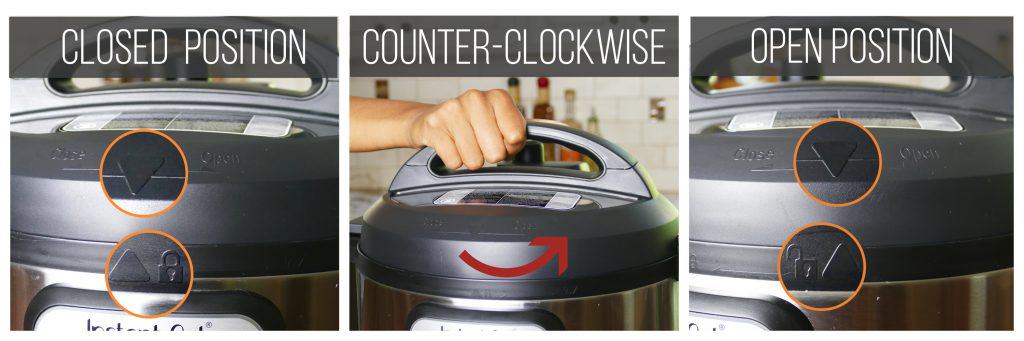
- If the lid is on, turn the lid counterclockwise until you hear a chime.
- The arrow on the lid will be lined up with the open lock icon on the base unit.
- Lift the lid to remove it.
- If you’ve just finished pressure cooking something and feel a slight resistance, wiggle the lid back and forth, and the suction should release.
How to close the lid
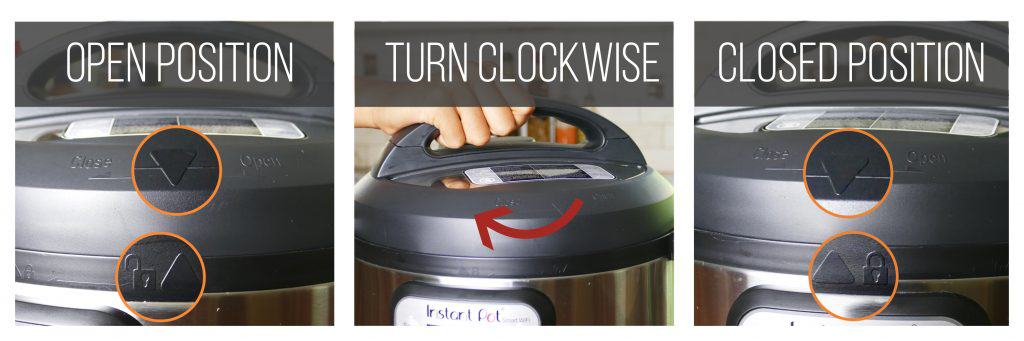
- Here’s how to put the lid on the Instant Pot: place the lid onto the Instant Pot base unit with the arrow mark on the lid lined up with the open lock icon above the right corner of the control panel.
- You will hear a chime (if the volume is turned on).
- Turn the lid clockwise until you hear another chime.
- The lid will be closed.
Float valve positions
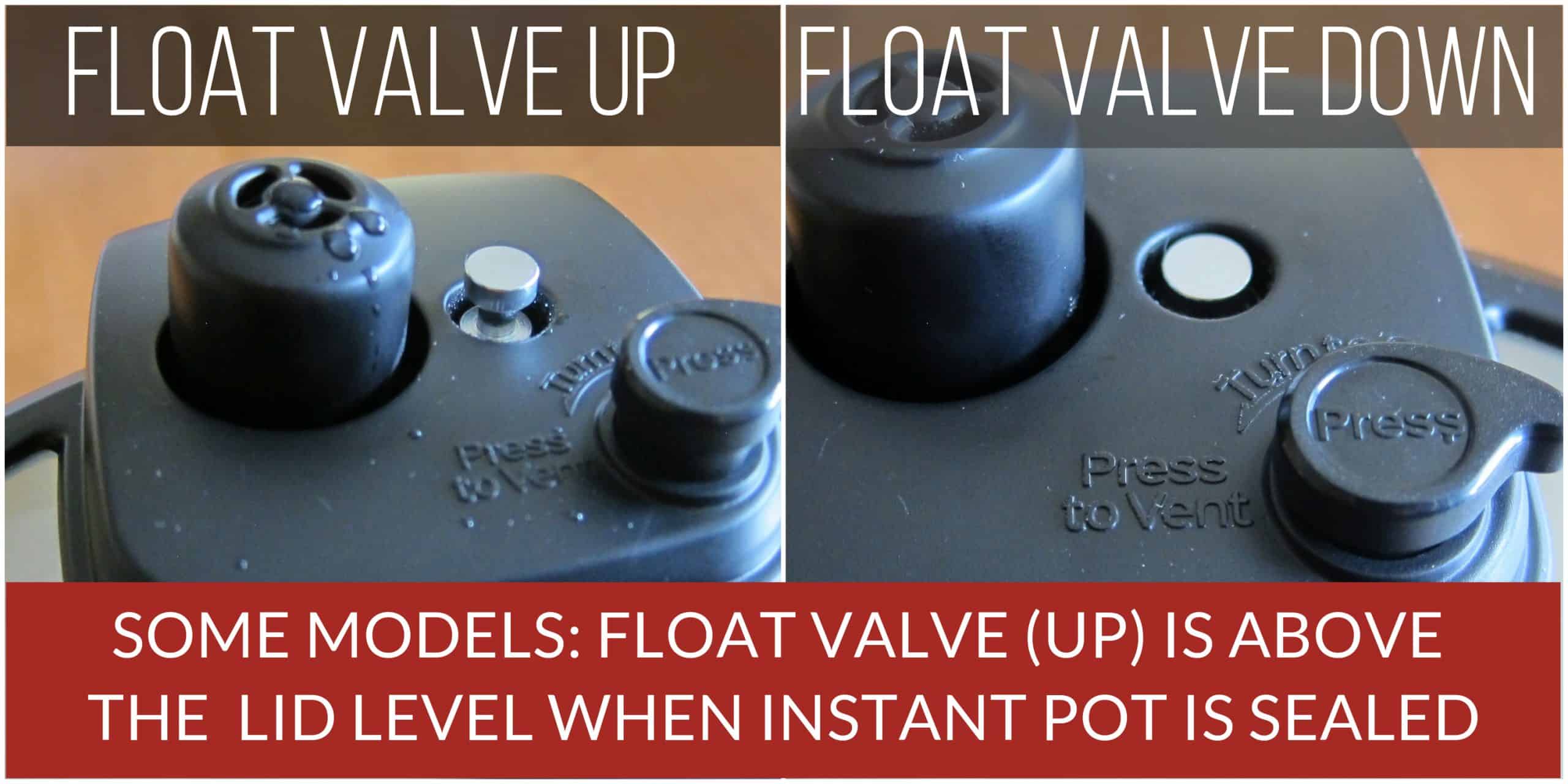
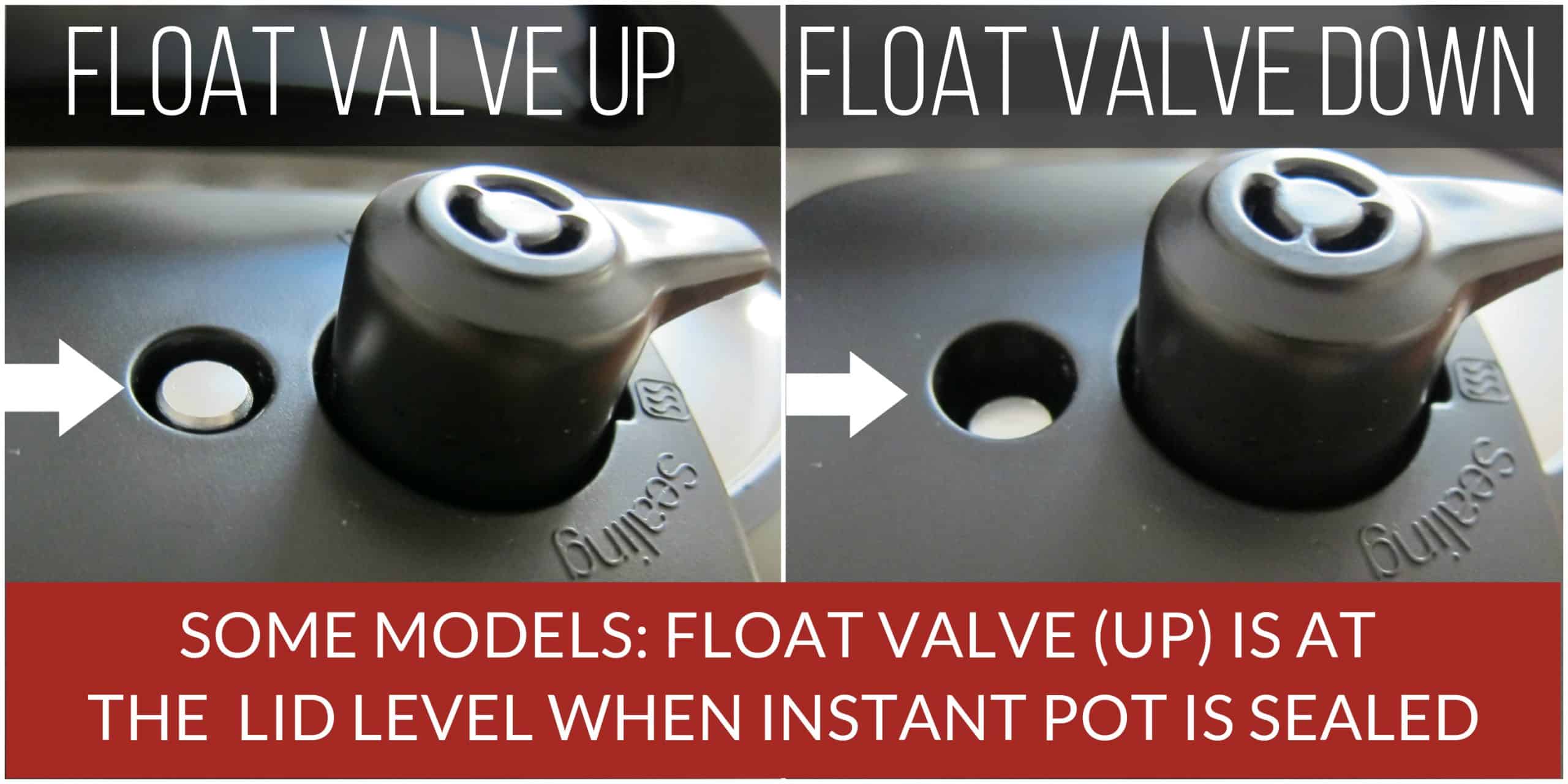
- In some models, the float valve is above the lid level when under pressure and at the lid level when not under pressure.
- In other models, the float valve is at the lid level when under pressure and below the lid level when not under pressure.
Safety Precautions
There are many built-in safety features, including automatic pressure sensors. However, as a user, you need to follow essential safety guidelines, including:
- Don’t touch the hot surfaces, particularly the stainless steel parts. Use the handles to move the Instant Pot and gloves to remove the inner pot.
- Keep hands and face away from the steam and pressure release mechanism.
- Don’t move the Instant Pot when it’s under pressure.
- Don’t fill over ⅔ full. However, when cooking foods that expand, e.g., rice, beans, and pasta, don’t fill over ½ full.
- Don’t open the Instant Pot until the float valve is down, i.e., the Instant Pot is depressurized.
- Don’t obstruct the steam release valve when pressure is released.
Instant Pot Water Test Instructions
What is the Water Test?
A water test is done by pressure cooking water for a few minutes. This allows you to familiarize yourself with the basic operations and ensure your new Instant Pot works.
You should do a water test before the first use, but you can also do it when you have problems with the Instant Pot pressurizing. The water test will pinpoint whether something about a particular recipe is causing your sealing issues.
How to do the Initial Test Run / Water Test
- Pour water into the inner pot. (1 cup for 3 qt, 1.5 cups for 6 qt, 2 cups for 8 qt).
- Close the lid and put the steam release valve, button, or switch into the Sealing position.
- Select the Manual or Pressure Cook button. Some models have buttons, while others have a knob.
- Change the cook time to 5 minutes using the + or – buttons or knob.
- On models with a Start button, press Start. On models without Start, it will automatically start in a couple of seconds.
- The display will change to On.
- Soon, you’ll hear and see small amounts of steam coming from the top of the lid. This is normal and safe! Just keep your hands and face away from the steam. You might also notice a plastic smell. Don’t worry – it will go away and shouldn’t happen again after the first use.
- Once pressure has built up, the float valve will come up.
- After the float valve comes up, the display will change from On to 5 (or 00:05), which can take a few minutes.
- The display will count down from 5 to 0 or (00:05 to 00:00).
- When pressure cooking is complete, you’ll hear a series of beeps, and the display shows L0:00, which means it’s in Keep Warm mode (if the Keep Warm function is turned on.)
- Press the Cancel button. The display will say Off.
- Do a quick release or manual pressure release by moving the steam release knob, button, or switch from sealing position to venting position. Keep hands and face away from the flow of steam. Once all the pressure inside the pot has been released, the float valve goes down, and the Instant Pot is de-pressurized. This can take a few minutes. You can also let the pressure release naturally, which takes 10 to 15 minutes.
- Once the pressure has been released, it’s safe to open and prop the lid.
What to do if the water test fails
If the water test is successful, you can use your new Instant Pot. If it fails and you’re not able to get the Instant Pot to come to pressure, use the following articles to troubleshoot the issue:
Instant Pot Buttons
- Each Instant Pot model has different buttons. Some buttons are cooking modes or programs (e.g. Rice, Bean) while others are operational (e.g. Cancel, Start).
- On some models, pressing a cooking mode button toggles between Less, Normal, and More, which have customizable default cooking times. You can adjust the time by pressing + or – and set High or Low pressure by pressing Pressure Level.
- On other models, pressing a button lets you customize the pressure level and cooking time using the display panel.
Programs and Default Times
| Button | Less | Normal | More |
|---|---|---|---|
| Bean/Chili | 25 minutes | 30 minutes | 40 minutes |
| Cake | 25 minutes | 40 minutes | 50 minutes |
| Egg | 3 minutes | 4 minutes | 5 minutes |
| Meat/Stew | 20 minutes | 35 minutes | 45 minutes |
| Multigrain (Soaks for 45 minutes first) | 20 minutes | 40 minutes | 60 minutes |
| Poultry | 5 minutes | 15 minutes | 30 minutes |
| Porridge/Oatmeal | 15 minutes | 20 minutes | 30 minutes |
| Pressure Cook | 20 minutes | 35 minutes | 45 minutes |
| Rice | – | 12 minutes (Low Pressure) | – |
| Soup/Broth | 20 minutes | 30 minutes | 40 minutes |
| Steam | 3 minutes | 10 minutes | 15 minutes |
| Slow Cook | 180–190°F (similar to keep warm on slow cooker) | 190–200°F (similar to low on slow cooker) | 200–210°F (similar to high on slow cooker) |
| Yogurt | 106°F to 113°F (for Chinese fermented rice) | 110°F to 115°F (for incubating yogurt) | 160°F to 180°F (for boiling milk before incubating) |
Other Button Functions
| Button | Function |
|---|---|
| Start | Begin the current program |
| Cancel | Cancels the current program |
| Delay Start | Start the cooking at a later time |
| Fav | Saves custom presets (on some models) |
| Keep Warm | Keeps food warm after pressure cooking; tracks time since cooking completed |
| Pressure Cook | Primary pressure cooking function; adjust pressure level and time |
| Pressure Level | Toggles between High and Low pressure |
| Saute | Allows sautéing before pressure cooking |
| Sous Vide | Cooks food using the sous vide method. You can set the cooking time and temperature |
| Temp | Adjusts temperature (use + or – buttons) |
| Time | Adjusts cooking time (use + or – buttons) |
| Ultra | Customizes temperature, pressure level, and cooking time (Ultra model only) |
Air Fryer Functions (on applicable models)
Some Instant Pot models have an air fryer lid and a pressure cooker lid. These models have pressure cooker and air fryer settings. These are some of the common air fryer modes:
- Air Fry
- Roast
- Broil
- Bake
- Dehydrate
- Proofing
FAQs
The Instant Pot turns on as soon as it’s plugged in. Attach the cord to the Instant Pot (if it’s detachable) and plug the cord into an outlet. The Instant Pot will say Off.
– The Instant Pot first needs to be plugged in.
– If the display is blank, press any button to turn on the Instant Pot.
– Choose the program and set the cook time.
– To start pressure cooking, some models have a Start button. Press Start.
– Other models automatically start. A few seconds after you program it, the Instant Pot display changes to On, which means it has started cooking.
On older models of the Instant Pot, the Pressure Cook button is called Manual. If you see a recipe that tells you to use the Manual setting, use the Pressure Cook function.
On some models, to set the Instant Pot to high pressure, press the Pressure Level button. It allows you to toggle between High and Low pressure. On other models, select the Pressure Cook function, and you’ll be able to program the pressure level and cooking time on the display panel using the knob.
The amount of time it takes to reach pressure and the float valve to go up depends on the amount of liquid inside the cooker and the temperature of the food. The more liquid in the pot and the colder the food, the longer it takes the Instant Pot pressure cooker to reach pressure.
If the Instant Pot has about 2 cups of liquid, it may take 10 minutes for the Instant Pot to reach pressure if the food isn’t frozen. The Instant Pot can take 15 to 30 minutes if it has more liquid.
A trivet and a small dish are useful for Pot in Pot cooking. An extra sealing ring is also a handy accessory. A tempered glass lid is convenient for sauteing, using the Instant Pot as a slow cooker, or for Yogurt mode.
Recipes for the Instant Pot
I hope these Instant Pot directions have helped you get comfortable with your new pressure cooker. Now you’re ready to try your first recipe!
Don’t try to improvise or wing it with your first recipe. Select a recipe from a trusted Instant Pot or Pressure Cooker cookbook or blog and follow it as written.
If you want to make changes or adjustments, you might want to contact the blogger or ask for advice from an experienced Instant Pot user.
Try an easy chicken recipe like Instant Pot Chicken Stew, Instant Pot Chicken Curry Soup, or Instant Pot Thai Red Curry; a dump and start Instant Pot Pork Carnitas or Instant Pot Mac and Cheese; or Indian restaurant vegetarian favorite Instant Pot Chana Masala.
Related Articles
I hope you’ve found these Instant Pot pressure cooker instructions useful. Here are some more articles that are helpful to beginners and intermediate Instant Pot users.
If you found this article to be helpful, please share it on social media using the social media share buttons at the top and bottom of this post. Thank you so much!




Kristin Wing says
Very very helpful video and website! I’m newbie and this was so helpful
Paint the Kitchen Red says
Kristin – I’m really glad you found it useful. Thanks for your feedback!
Tricia says
Very helpful information thanks . Is the a creamy oatmeal recipe using old fashion oats?
Paint the Kitchen Red says
I’m glad you found it helpful, Tricia. I’m not sure which recipe you’re referring to because I’ve not posted an oatmeal recipe.
Melishia Hoffman says
Thanks for posting this! I was truly at a loss!
Paint the Kitchen Red says
Melishia, I’m so glad it was helpful to you. Enjoy your new IP!
Kathy C says
Oh. My. GOSH! I couldn’t find the quick start guide that came with the Instant Pot, and I have been trying to get the lid on for an hour. It was backwards. ? (Group eye roll!) Thank you so very much for making this quick guide. Bless you, bless you, bless you. Seriously. XX
Paint the Kitchen Red says
I’m so glad you found me, then! Don’t feel bad, we’ve all had those moments when we first got our Instant Pot. You should have seen me try to figure out where the condensation collector goes!
Betsy says
A GREAT BIG thank you!
Your step by step process was perfectly helpful.
I am 65 years old and have used a stove top pressure cooker all my life. Now I’m trying this new contraption and am reminded of my trepidation when first cooking with my mother’s pot. As the Instant Pot did not come with any instructions, it has been wonderful to find this page. I am looking forward to some easy-to-follow introductory recipes. Thank you again.
Paint the Kitchen Red says
Oh, I’m so glad and you’re welcome! Rest assured that the Instant Pot has lots of safety mechanisms and the chances of any disasters like with the stovetop version are slim to none. All my recipes are written with step by step instructions. Just read over them and keep all your ingredients ready. If you’re looking for the simplest, rice or eggs is a good starting point. Holler if you have any questions, I always try and answer in a timely way.
Allison says
Ah! The Manual had me so frustrated! This was soooooo helpful. Thank you!
Paint the Kitchen Red says
I’m so glad – enjoy your new Instant Pot!
Shanthini Jayanthan says
My item is coming tomorrow. Glad you have given an easy quick start guide.Thank you. Hope to try the chicken curry.
Paint the Kitchen Red says
Welcome to the world of Instant Pot! I’m sure you’ll love it!
Tabitha Bucknam says
Thank you so very much for this guide. I have a question that I haven’t gotten a clear answer googling
I’m running your water test. There were several times a lot of steam came from the steam release handle. I could hear and see it shooting up. I double checked the handle and it is in the “sealing” position. The float valve is up so there is pressure.
Could this be a defective unit?
Thanks again
Paint the Kitchen Red says
Hi Tabitha, once the float valve (silver) is up AND the countdown timer begins, you should see minimal to no steam coming from the float valve and pressure release handle (I usually have none.) However, before the float valve comes up, you can see steam coming through both float valve and pressure release valve. If you’re getting more than a tiny bit of steam once the countdown timer begins, try and jiggle the release valve and put it back in sealing position. Also take your sealing ring out, let it cool and put it back in properly. You might need to contact Instant Pot directly if you find the problem doesn’t resolve. But I would definitely try again.
Tabitha Bucknam says
Thanks so much for your quick reply. The steam is coming during the pressuring pricess before countdown. After some googling and videos looks like it’s normal. Can’t wait to use it for more than water. ?
Paint the Kitchen Red says
Yay, so glad that was resolved. You’re going to have fun trying out different recipes and adapting your own. Rice is a good thing to make for the first time – that’s what I did!
Linda says
I do understand your guide. Thank you so much. I have made several meals with my UP but was really only “winging” it, hoping I was doing it right. Your post and pictures made it so much easier to understand.
Paint the Kitchen Red says
I’m so glad, Linda! Enjoy your IP!
Wendy says
Wow – thanks for this clear and concise “getting started” guide… complete with pictures! I sure appreciate it… and am ready to do the water test now. Can’t wait to finally start using my IP! 🙂
Paint the Kitchen Red says
Thanks for the feedback, Wendy! Hope the water test went well. Enjoy your new IP!
Megan says
Thank you! I just got an IP and was so scared the first time I used it because the manual was so not user friendly. I’m feeling way more confident! I definitely could not figure out where the darn condensation collector was supposed to go, the photo in the manual was not descriptive at all. Thank you!
Paint the Kitchen Red says
I know! I thought the same thing. Those diagrams were really hard to follow. I was looking to put that condensation collector on the inside! Thanks for the comment – it makes me feel so good that my post is of help to others.
Joelle says
I am so excited to find your site! I just got my instant and have been quite nervous to try it. Thanks for all the detailed information…Now for the Country Style Ribs….Wish me luck!
Paint the Kitchen Red says
So glad you found me Joelle! Hope the ribs came out well – you’re going to love your new IP!
Tina says
Thank you so much for taking the time to write this and add photos for each step. I don’t know how I missed the valve setting – no wonder my beans never cooked! Thanks again – your efforts are greatly appreciated!
Paint the Kitchen Red says
Tina, I’m so glad that you found your answer! Happy to help.
Lesley says
Thanks for the step by step.
I was reading on the instant pot site and they said the current version of the instruction manual says fill water to 3 mark, but it apparently should really only be 1 cup for the water test.
Paint the Kitchen Red says
You’re welcome! You can do the 3 mark, Lesley – but it would take forever! 1 cup is fine – takes less time, and it allows you to test out the Instant Pot to make sure it reaches pressure.
Spencer says
Let me add my appreciation for your wonderful guide. Well Done!
But simple question: Adjusting the time.
I wish to cook a pot roast. Hit “Meat”…then adjust time. But rather than simple ‘more’ or less’, ‘up’ or ‘down’, it displays blocks of time in undefined units.
The sequence of button pushing is very unclear..to me!
Thanks in advance.
Paint the Kitchen Red says
I’m really not sure what you’re seeing, but you should just be able to press ‘Meat/Stew’, adjust the time with ‘+’ or ‘-‘ and it will display ‘On’. Once it reaches pressure it should display the number of minutes left to cook. Maybe you’re pressing the ‘Adjust’ button? This changes the pressure from less to normal to more, in which case the display will change the amount of time required to cook the meat. You can adjust that time with ‘+’ or ‘-‘. Hope that helps!
Sharron says
I have an IP DUO60 V3 and there is not an adjust button on the control panel. I have been trying to figure out how to adjust the mode (less, normal, more) when doing any of the cooking programs listed in the manual. The + and – signs seem to change only the cooking time. When non-pressure cooking yogurt, my manual says you can adjust from less to normal to more by pushing the yogurt button repeatedly. Do I have to do that with any of the program buttons to change the mode as well?
Paint the Kitchen Red says
Hi Sharron. It can be confusing, so you’re not alone! The model you’ve listed has an Adjust button with a yellow border. Are you sure that’s your model? What you’re describing sounds like it’s the Duo Plus. Can you please confirm before I answer? You’re welcome to email me a photo of the control panel at paintthekitchenred gmail.com.
Kathy says
I just got the same model for Christmas 2017 ( IP DUO60 V3) and it also has no adjust button. Very confusing.
Paint the Kitchen Red says
Kathy, the adjust button on the model I have is used to toggle between the less, normal and more settings for each mode of cooking. So for example for Saute, you press Adjust to toggle between the different levels. On your pot, I believe you just press Saute again and again to toggle between the settings. Let me know if that works for you. Good luck.
Lisa says
Thank you! I keep joking (not really????) that I need an IP for dummies book. Thanks!
Paint the Kitchen Red says
I love those ‘for Dummies’ guides! I’m so glad you found it helpful.
Wonkytonk Woman says
There actually is a ‘Dummies Guide’ for electric pressure cookers. BTW, I am also on WW and hope that some new recipes will help me to lose more weight. 55 down and 35 to go!
Sarah says
Very helpful thanks. Can’t wait for some curry recipes! 🙂
Paint the Kitchen Red says
Hi Sarah, Chicken curry will be posted tomorrow – please check back! If you’re not yet subscribed to the newsletter, please consider signing up, and when I post a new recipe you’ll know about it.
LaRene Wolfe says
These are very clear directions without making anyone feel dumb! Thanks!
Paint the Kitchen Red says
Thanks so much for your feedback, I’m really happy they helped you! I will continue to post detailed instructions then.
Amy C says
Thank you for posting this SUPER helpful guide for us newbies!!! I was wanting to know when it was safe to open the IP lid !! Feeling a little more confident after trading your guide and going to try to cook our New Year’s traditional black eye peas and following up with cabbage!
Thanks again and Happy New Year!
Amy C says
*reading!! ????
Paint the Kitchen Red says
I am so very glad that was helpful to you, Amy! Good luck with the black eyed peas and cabbage.
Lindsay says
I recommend your guide to anyone who wants to use this time-saving device in the kitchen. Thank you for clear, concise directions, and the photos help to clarify. You could teach a master class on the Instant Pot!
Paint the Kitchen Red says
Thanks Lindsay – I try to make it user-friendly!
Vivian Winn says
Where do I find your recipes. Thank you for your easy and useful directions.
Thanks
VIVIAN
Paint the Kitchen Red says
Hi Vivian – all my recipes can be found if you click on the ‘RECIPES’ on the menu bar on the desktop. On the mobile phone, click on the three lines (like a hamburger!) at the top of the post. Here’s the link though: https://www.paintthekitchenred.com/recipes/. I hope you enjoy the recipes!
Marcyann says
I’ve ordered the 9in 1 multi programmable pressure cooker and since have read some reviews that were awful. Does this model have problems?
Paint the Kitchen Red says
Marcyann, I have not heard of the 9-in-1 having more problems than other models. What I would suggest is that you make sure you use it to cook all kinds of different recipes in the warranty period and that way you’ll be able to know if there are any issues and return if need be.
Jennifer hartfelder says
Yes thank you so much, I like your version it is clear and easy to follow. Whoever wrote this instruction manual needs to read it from a beginners point of view. Thanks again!
Paint the Kitchen Red says
Glad you found it useful! Good luck with your new Instant Pot, Jennifer.
Leslie Birkett says
I was embarrassed to admit that my new, wonderful Instant Pot was “scary!” THEN I read your article. . .I am “cooking” my first dish. . .water! LOL. Hopefully I will be successful in cooking dinner tonight. Thank you so much!
Paint the Kitchen Red says
You’re welcome. We’ve all been there – nothing to be embarrassed about ? What did you make first?